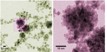
Researchers at the National Institute of Standards and Technology (NIST) have developed a fast, simple process for making platinum 'nano-raspberries' -- microscopic clusters of nanoscale particles of the precious metal. The berry-like shape is significant because it has a high surface area, which is helpful in the design of catalysts. Even better news for industrial chemists: the researchers figured out when and why the berry clusters clump into larger bunches of 'nano-grapes.'
The research could help make fuel cells more practical. Nanoparticles can act as catalysts to help convert methanol to electricity in fuel cells. NIST's 40-minute process for making nano-raspberries, described in a new paper,* has several advantages. The high surface area of the berries encourages efficient reactions. In addition, the NIST process uses water, a benign or 'green' solvent. And the bunches catalyze methanol reactions consistently and are stable at room temperature for at least eight weeks.