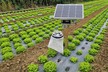
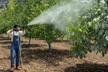
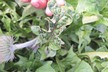
Christian Scaronne grows germini in 25 different varieties. His company has a surface area of 2.3 hectares. He started three years ago with biological crop protection. ‘Chemicals were becoming more and more expensive and they were less and less effective. I also wanted more safety for my employees. The biological approach was a hitherto unknown tool that I wanted to try in my company.’ Spider mites and leaf miners were then the worst troublemakers, followed by whitefly and thrips. Christian Scaronne tackles them now with a number of natural enemies: Swirski-Mite (Amblyseius swirskii), Thripex (Neoseiulus cucumeris) and Limonica (Amblydromalus limonicus) against thrips, Spical (Neoseiulus californicus) and Spidex (Phytoseiulus persimilis) against spider mite, Amblyseius swirskii against whitefly, and Bacillus thuringiensis and sticky traps against caterpillars.
Learning process
It took quite some time to master the new approach, Christian Scaronne relates. ‘We introduced too few natural enemies and we didn’t introduce them often enough. Later everything turned out well. Together with Koppert France, we also spent a good deal of time on the learning process: How should you use natural enemies, how many natural enemies do you need to use, and what do you need to pay attention to should you unexpectedly need to use a chemical corrective agent? And so on.’A better vase life
For Christian Scaronne, who sells his products through the auction, the advantages of biological crop protection have become clearly visible. The crops develop more easily, they have less stress to deal with, and the colours of the germini are brighter. ‘The vase life is better and the plants seem to produce more stems.’ For two years the company, which is situated in Hyères on the French Riviera, has had a permanent relationship with Koppert France and with consultant Thibault Crance. Christian Scaronne is working together with him on two problems that are still quite troublesome: powdery mildew and leaf miners.Much more harvest security
In conclusion, Christian Scaronne says, ‘Without the biological approach towards insect infestations my company would not immediately be in difficulties but in future that could well be the case. With the prices of chemicals being what they are and with the fact they are losing their effectiveness, the biological approach gives us much more harvest security.’For more information:
Koppert Biological Systems
Email: [email protected]
www.koppert.com