The MENNO Florades disinfectant is dispensed with the skumix applicator as a dense creamy foam, ensuring it stays in place for long enough to be soaked up in spores, fungi and other pathogens on smooth surfaces within a greenhouse environment.
“On vertical surfaces the foam is able to remove dust and dirt because of its own heavy weight, lifting it as it goes.
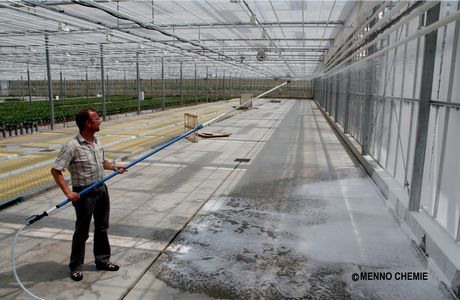
“We can bring it from the vertical surface down to the horizontal surface so it acts as a mechanical cleaning effect,” says Nevermann.
The skumix also ensures precision application, and that the correct amount of active ingredient per m2 is applied to the surface; and the expanding properties of the foam enable it to penetrate cracks and interstices, maximising its exposure and effectiveness.
But how long does does it need to be left on?
The longer the better according to Jan Nevermann, “it breaks down the treated area and builds a water film before drying off.
“For best results, the product has to stay on the surface to get the long term benefits, and because of Benzoic acid there is no visible residue on the surface later on. Benzoic acid is a legal preservative for food.”
Although it’s not ideally recommended for use in a greenhouse with a current crop cycle, it can be used without causing unnecessary damage to plants.
On application, the foam doesn’t release any toxic vapours meaning it is also much safer for nursery workers and anyone administering the product.
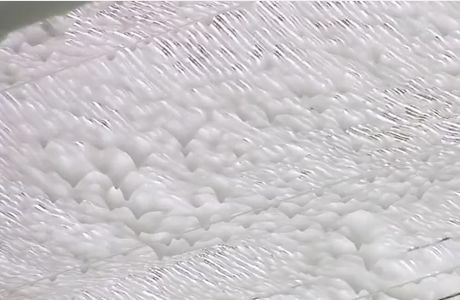
MENNO Florades disinfectant foam can also clean and disinfect screens
“This is very important because if you are having problems with Botrytis you have to make some barriers in the greenhouse and make sure contamination is not spreading to the next phase [of the crop],” Nevermann says.
Currently registered for use Europe-wide and beyond, MENNO is hoping their innovative product changes the way commercial greenhouses are disinfected.
“Our recommendation is to do it as a precaution every time [at the end of a crop]. So if you produce tomatoes you should do it once after the harvest. To ensure there is no infection from one crop to the next,” concludes Nevermann.
For more information
 MENNO Chemie-Vertrieb GmbH
Jan Nevermann
[email protected]
www.menno.de