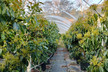
A wireless sensor network may offer useful insight into horizontal temperature distribution in the greenhouse, as is shown in the project 'Improve temperature equality by climate monitoring', performed by Climeco Engineering and commissioned by KAE. The new findings may help growers to improve the greenhouse climate and prevent energy loss. The final report is now available.
New insight
During the project, five greenhouse companies with diverse crops (tomato, cucumber, pepper, phalaenopsis and gerbera) measured the horizontal balance through a wireless sensor network. In two sessions, the temperature and relative humidity at many locations in the greenhouse was recorded. The results were displayed using 'heat maps' and graphs on a website.
Causes
The measurements showed that cracks in the screens are a big booster for temperature differences in the greenhouse. This is particularly the case in larger greenhouses, and when lower temperatures are maintained. The slope of the greenhouse shows great influence on temperature distribution. Also the location of the concrete appears to affect things, but this is difficult to substantiate.
During the night, wind speed and outside temperature prove to be a great influence on variations in the greenhouse. During the day, solar radiation is dominant. It is suspected that pressure in the greenhouse has a positive effect on proper balance.
Source: Energiek2020