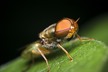
Summertime is a busy one for Plant Research International (PRI) at WUR. Currently, several studies are underway, says dr. Rob van Tol. One of note being the study on Heteroptera (or simply ‘bugs’) in cucumber plants.
The hairy bug (Lygus rugulipennis) is a brown bug of no more than half a centimetre wide. The bug feeds itself by pricking tiny holes into the flowers of cucumber plants. "These bugs can cause considerable damage that way," says Van Tol. “There are several natural enemies in existence, but in cucumber cultivation those are of no use. It’s not about removing eggs or larvae with predatory insects, but about preventing adult bugs from entering the greenhouse in the first place." Pheromone traps are typically being deployed to catch them.
Overall though, the solution to the pest problem lies in a so-called standing army. "Through controlled culture systems, a grower can ensure a continuous population of biological agents, having it on stand-by just in case. With our research we can help them find the right recruits for such an army.”
Combating viruses is a lot more difficult, says researcher Dr René van der Vlugt of PRI. "Once you have an outbreak of, say, the mosaic virus, you’re fighting a losing battle. Preventing a plant from becoming infected is the best alternative. Heating the seeds is a good option. After which you should test for the presence of live virus particles on the seeds. Which, of course, is tricky. A common test for the detection of viruses searches for proteins on the outside of a virus particle, but this method has proved inadequate in the past. We are currently working on a genetic test that scours through large pieces of genetic material more vigorously.”
"The interests in this industry are great,” Van der Vlugt confirms. “It’s a regular arms race, to tell the truth. Always trying to stay a few steps ahead. In our business, that is an absolute must. A supplier of breeding material wants to know for certain if his goods are infected or not. We try to find a sound scientific basis to explain why one agent protects cucumbers and another does not."
Source: WUR