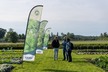
Zeta Seeds Italia has recently held a meeting on Iceberg lettuce in Syracuse (Sicily), to which 25 companies who specialize in Iceberg and Roman lettuce were invited.
The meeting room.
As Stefano Campazzi from Zeta Seeds says, "the companies involved were able to share their experiences with the other companies and with our representatives. In fact, growers are considering the idea of producing in Winter and Spring not only for the domestic market, but for the foreign one as well."
The objective of the meeting was in fact not only that of getting to know what was new in terms of varieties, but also to make a confrontation with Spain, the leading producer in Europe and probably the world (after US and China) and the main exporter worldwide.
The meeting was the perfect chance to listen to what the Spanish geneticist manager of the lettuce department had to say. He presented a report on the current market situation, on the commercial requisites required by purchasing countries and the competition and differences between the produce from Calabria/Sicily and Spain.
"The analysis showed how Germany requires big volumes at low prices; Great Britain purchases big volumes at higher prices and with a higher quality and then there are countries such as Northern-Eastern Europe."
The Spanish leadership and the chances for Italian supply
As previously mentioned, Spain has the main role as regards lettuce, both in terms of volumes - 28-30,000 hectares between October and May - and in terms of continuity and customer service. It also uses prices as a further weapon to defend its share of the market.
"The quality requisites have been clearly stated, even though we produce at different times than Spain, but there is the need to promote the same type of produce."
"To achieve this objective, the best varieties must be chosen. ZSeeds Italia showcased its range, which can take the company through the different seasons, as well as its position in terms of seasons and production areas, growing techniques and collaboration with the companies who attended the meeting."
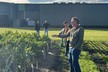
Lettuce trial field.
Spain (Murcia) has the main role, as it exports 80% of its production, because it did an excellent job in building relationships with the markets and because it has a really wide range of lettuce (not only Iceberg!).
In addition, Spaniards guarantee the quality of the heads (9-10 pieces per box), and their production is certified and traceable for the best part of the year.
The critical aspects of the Spanish production are the heavy rains in Autumn (as happened in 2012) which affects production and the lack of water in Winter and Spring, which affects productions to be carried out after April.
Stefano Campazzi observes: "If we consider all this, Sicily can grow thanks to its geographical position, excellent quality of producer companies and by supporting local growers through the production chain such as the Mondoverde nursery garden (guided by Alessandro Indorato), which has always introduced new materials that could exalt the productive aspects and the quality of the territory."
"Sicily can develop its production from October until May, guaranteeing better-lasting produce, which might also be organic (an area that still has to be explored!) and aimed at supplying produce for the fresh-cut sector (which is expanding in Europe). At the same time, we cannot avoid mentioning the excessive fractioning of productions, which does not help volumes and continuity and which limits companies because of higher costs."
What's changing in the European lettuce market
Roman lettuce is conquering new markets day after day: in the last 25 years, Iceberg lettuce went from 23.7 kg per person to 15.5 whereas, in the same period, Roman lettuce went from 3.3 to 10.7 kg, three times the initial amount.
"Roman lettuce is in fact more fragrant, tastier and it lasts longer with respect to Iceberg: therefore we must be careful of supplying Roman/little gem lettuces to already developed markets as they refer to consumers that are more careful, as they have better organoleptic qualities."
During the meeting, producers confirmed the quality of the ZSeeds Italia range, and talked especially about the varieties which performed well:
- Kavir, the Summer variety.
- Almirez intermediate and, subsequently, Makan.
- Carù, Autumn-Winter / Winter.
- Sinai and Alamos, the kings of Winter.
Alamos iceberg lettuce.
- Avellan for Winter-Spring.
Avellan iceberg lettuce.
- Tabal / Tanami to be harvested in May and concluding with Almirez, the most eclectic of the Summer-Autumn-Spring lettuces.
For further information:
Zeta Seeds Italia
Via G. Pallotti, 14/a-b-c
40133 Bologna - Italy
Tel . +39 051 833555 / +39 051 351334
Fax. +39.051.839333
Email: [email protected]
Web: www.zetaseeds.it
Stefano Campazzi
Mob.: +39 329 8474284