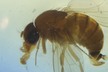
For the second year now Syngenta is following the development of Amblyseius Montdorensis at a number of companies. The development of the predatory mite and its contribution to thrip control is accurately determined and compared with those of other predatory mites. The results so far are very convincing for this small but very active mite. Montdorensis is used in the Dutch greenhouses by means of small sachets (Montyline). These release a large amount of predatory mites for a period of 6-8 weeks.
Montdorensis is a "broad spectrum predatory mite", meaning it fights both thrips and whiteflies and actively attacks thrips in both first and second larvae stage. At the start of cultivation, development of Montdorensis is seemingly identical with that of Swirskii and Cucumeris, but from week 12 a massive egg production is visible, which weeks later results in a huge increase in the number of predatory mites. Also in the flowers Montdorensis is massively present.
Experiences of the past two years have shown that the presence of predatory mites continues throughout the year in good numbers, while that of Swirskii and Cucumeris tends to peter out towards the summer. In addition, the active nature of A. montdorensis is a very distinctive feature: it runs very fast and is very voracious.
Syngenta
Vince van der Gaag
Website