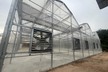
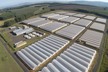
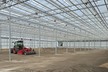
Co.Ser. produces iron-plastic greenhouses (covered with either plastic film or semi-rigid materials) which, thanks to their lower costs with respect to iron-glass greenhouses, have rapidly developed in the last thirty years. In addition to greenhouses for the fruit and vegetable sector, Co.Ser. also manufactures structures for the flower and plant nursery industry, as well as solar greenhouses and warehouses.
Alessandra di Maio, one of the partners, explains how "Co.Ser. was founded in 1992 by some farmers who realised the potential of this new type of greenhouse and who studied the various structures suitable for the weather conditions and the needs of farmers in Central and Southern Italy. They therefore designed greenhouses that are very easy to assemble and cover, load-resistant, with excellent ventilation and energy saving."
All of the above characteristics, together with great versatility and the availability to customize structures are at the basis of the development of the company in Central and Southern Italy, as well as for its expansion all over Italy, in Europe and overseas.
"Our clients make various requests, and our supply ranges from simple and affordable greenhouses to state-of-the-art technological structures. Of course, the choice depends on the type of investment. In addition, our greenhouses are constantly improved by the farmers themselves thanks to customization, confrontation and to our knowledge of any possible design problem."
The companies and the crisis
"As far as we have witnessed, those companies that are well structured and integrated in the sector continue to make investments. Despite the crisis, demand for greenhouses is still stable even if lower than that at the beginning of the '00s, though an increase is to be expected in the medium-long term."
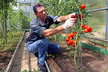
The advantages of cultivating vegetables, especially peppers, tomatoes, salad, radishes, courgettes and strawberries, in greenhouses rather than on field are many. On the one hand, there are environmental advantages such as the protection from natural weather phenomenons (rain, wind and snow) and from animals. In addition to this, there is the possibility of creating a different climate than the outdoor one and of controlling irrigation and fertilization. Finally, there is less need for pesticides and disinfectants, as farmers have to deal with a closed environment, and also because the greenhouse itself generates some sort of protection thanks to climate control and anti-insect nets.
On the other hand, there are economic advantages. As can be testified by farmers, the yields of greenhouse crops are 2-3 times those of traditional crops and the quality is better.
"Greenhouses are almost the only choice for those Italian farmers who want to be competitive on European markets in order to comply with the strict European regulations concerning agricultural products, fertilizers and disinfectants and well as to make more profits by selling extra-seasonal produce."
The future
"We are expecting the same turnover as 2012 for structures for industrial farming, whereas the demand for small greenhouses should increase. We have in fact designed two affordable mini-greenhouses - €500 for the 3x6m one and little more than €600 for the 4x8m one - precisely because of requests coming from hobby farmers. They are people who want to eat healthy and genuine produce and who want to reconnect with nature and tradition, therefore they only want to cultivate for their own household."
"If we talk about the medium-long term, experts expect an increase of greenhouses worldwide. This will be caused by the increase of population, reaching 9 billion people, who will need more fruit and vegetables which will have to be created using less resources as they will be scarce. This in turn will lead to an increase of greenhouse crops," concludes Alessandra di Maio.
Contacts
CO.SER. srl
Alessandra Di Maio
Via Provinciale per Mondragone
81050 Francolise (CE)
Tel.: (+39) 0823 1763485
Fax: (+39) 0823 884180
Email: [email protected]
Web: www.coseritalia.com