There's an old Italian saying which goes "tell me what courgette you eat and I'll tell you where you come from." In fact, not only is Italy a great producer and consumer of courgettes, but it is also a land of biodiversity, as the best part of the species gene pool comes from the peninsula: the Romanesco and Genovese varieties, green courgettes linked to the green archetype from Milan, the "Caserta", better known as Greyzini, and the Round Florence are only some of the most popular ones.
In the last few years, courgette consumption has constantly increased, pulling up national production with it. Nowadays, the trend is rather stable, but courgettes are still one of the most interesting vegetables from a commercial point of view because they can be eaten in many different ways and are ideal for low-calorie diets.
A twelve-month production
The product is cultivated at a national level throughout the whole year. Greenhouse winter productions are concentrated in Sicily and in the Agro Pontino (Central Italy) area, though the two areas also have open field production capacity. Cultivated lands are only affected by commercial decisions taken during long periods with low prices.
Open fields are cultivated all year round, especially in Piedmont and in the North-East.
Greenhouse crops (Types)
Greenhouse crops (Areas)
As regards protected cultivation, the North, and especially the Verona area (Veneto), cultivates mainly the early-harvested green type with flower in the spring cycle. Latina (Lazio) has two transplant cycles: a short cycle in September harvested until December/January and a long cycle in November harvested until June. Sicily also relies on different transplants: a short cycle in tunnels in September harvested until December/January; a long cycle in October harvested until April/May and another long cycle in November harvested until April/May.
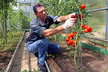
Courgettes in a tunnel.
Production is mainly aimed at the internal market, with only a small quota (though considerable in terms of volume and absolute value) of green courgettes destined to be exported to Germany.
White courgettes are consumed at a local level in Sicily and Calabria, and some of them are sold also in Bologna during winter. Greyzini courgettes, harvested with their flowers, are consumed in the whole Tyrrhenian area reaching to the South of France. Emilia-Romagna also produces and consumes this variety, as well as the Bolognese. Romanesco/Florence courgettes are instead only consumed in Lazio and Tuscany. Exports of organic courgettes are rather dynamic and they mainly concern the green variety shipped from Sicily.
Using courgette flowers in the kitchen turns out to be an Italian phenomenon. Male flowers are stuffed, fried or eaten with pasta and they are hugely popular both at home and in restaurants. Sometimes our profits are actually saved by this wonderful idea!
There are some projects studying the possibility of supplying the market with courgettes with a specific use. The many varieties, together with the fresh-cut and already-cooked ranges could promote the consumption of packed produce with its use indicated on the label i.e. pre-cut (julienne, sliced, "ready to grill", etc.), stuffed ready-to-cook and pre-cooked.
As regards imports, Morocco and Spain do supply produce during winter, when it is reasonable to rely on prices that make a profit and only on the green variety. Courgettes suffer long distances anyway, and refrigeration and foreign produce are mostly used to moderate prices if there's not much produce available.
Open field crops (Types)
Open field crops (Area)
As can be seen by the charts, open field production is shifting towards the North and therefore towards the big markets. Variety ratios also vary as, for example, it is more difficult to harvest with flowers in open fields. A relevant part of produce comes from Puglia as well, because of the demand coming from the processing sector.
Open field cultivations start at the beginning of May at a national level and, in some areas, they repeat in July/August. Production ends towards winter and when fresher produce comes from greenhouses in September.
As regards unit production per hectare, there are great differences due to the length of cycles and plantation layouts. In greenhouses, long cycles with 1.4 plants/m2 can reach peaks of 140 ton/Ha, whereas in open fields, with only 20 fruits per plant and 0.9 plants/m2, around 18-20 ton/Ha are harvested.
Problems
This product has many problems due to abiotic stress, downy and powdery mildew and all of those viruses in open air cultivations.
Genetic research has made huge leaps forward, offering an excellent number of varieties especially for the green type. Varieties destined to the various productive cycles and with a wide set of genetic resistances (CMV, ZYMV, WMV, PRSV, Px) have been available for a few years. The "Moroccan" variant of the WMV, i.e., the MWMV, has been causing many problems in the last few years especially for open field transplants and for the first greenhouse transplants in September.
White courgettes.
At the moment, there are less varieties and resistances in the other types because of the small dimensions of their markets, although at Enza Zaden we are investing in "minor" types. Not only do we research resistances and productive performances, but we also aim at an all-round approach to the whole chain. Variety diversification according to specific uses and low-nitrate content are only part of our contribution to this beautiful species.
For more info: [email protected]
White courgettes.
At the moment, there are less varieties and resistances in the other types because of the small dimensions of their markets, although at Enza Zaden we are investing in "minor" types. Not only do we research resistances and productive performances, but we also aim at an all-round approach to the whole chain. Variety diversification according to specific uses and low-nitrate content are only part of our contribution to this beautiful species.
For more info: [email protected]