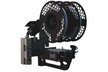
'Mercury', developed by the Spanish firm Maxfrut S.L, is the first intelligent electronic calibrator in the market able to classify by colour, size and shape at a speed of 30 pieces of fruit per second.
Based in the Valencian city of Alzira, Spain, Maxfrut S.L. is a manufacturer of post-harvest machinery specialised in calibration of all sorts of fruits and vegetables, from Cherry tomatoes and cherries to melons, watermelons and onions, except for products such as potatoes.
'Mercury' allows for the calibration of fruits with a diameter between 15 and 50mm. It has an artificial vision system that measures the diameter of each piece of fruit and determines its colour, allowing for optimal calibration at great speeds. It has LED strobe lights and the video cameras are equipped with MultiScanUltra Speed and ProgressiveScan. It also includes an electronic weighing machine.
'Mercury'
The manufacturer has just introduced its cutting-edge calibrator in the Mexican firm Empaque Hortalizas El Porvenir, adapted to the firm's specific needs, particularly for Cherry and Cocktail tomatoes. This way, 'Mercury' becomes the first machine of these characteristics in Mexico.
"Products such as Cherry tomatoes and cherries are very fragile fruits; for this reason, one of the machine's greatest advantages is its use of compressed air to eject the fruit towards the exit, avoiding all contact," explains Stephane Mérit, Maxfrut's Commercial and Exporting Director.
'Mercury' calibrator at Empaque Hortalizas El Porvenir.
"Mexico is becoming a large market in terms of horticultural production thanks to its proximity to the United States, its export market by default. To meet demand, it needs more and better technology. With the introduction of 'Mercury' at Hortalizas El Porvenir we begin the process of implantation of our machines and our technology in Mexico and we thank Hortalizas El Porvenir for their trust."
Roberto Camacho, Manager of the Mexican firm Empaque de Hortalizas El Porvenir, located in the state of Sonora, is very satisfied with the acquisition.
"Without a doubt, this sorting machine has changed the way we work with small tomatoes. In the past, the impact on efficiency in the production line was a serious issue, both in financial and operational terms," he affirms. "It is the best investment we have ever made since we started the project."
Many are the advantages that this system is bringing compared to manual calibration and selection. "The main advantages are the reduction of the workforce during packing, the precision in the quality ratings established by the market and the amount of time it saves compared to manual packing. This makes our job much easier and reduces costs in many ways."
While the United States is a very demanding market in terms of quality, Roberto Camacho says that the 'Mercury' calibrator gives them peace of mind due to the way it treats the fruits. "It treats them with plenty of care and precision. Additionally, with faster packing the products are also shipped earlier and their shelf life becomes longer."
"We can access the US market with the certainty that our products have been perfectly selected by size, weight and colour," he concludes.
For more information:
Stephane Mérit
Maxfrut S.L.
Avda. De los Deportes 14.
Alzira, (Valencia). Spain
Tel: +34 962401214
Roberto Camacho
Empaque de Hortalizas El Porvenir S.A.
Col. Marte R. Gómez, Cajeme, Sonora. Mexico
Tel/Fax:(644) 4 42-1052