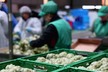
The flowers come from Kenya and Tanzania in East Africa. Almost all of them are Fairtrade products. From Kenya’s capital Nairobi a substantial number of the roses are transported to Germany in MD-11 freighters from Lufthansa Cargo.
“We prefer to load with Lufthansa Cargo,” says Omniflora Managing Director Klaus W. Voss. “There are currently five flights per week from Nairobi to Frankfurt, and we have goods on board each one.”
Last year, the company imported approximately 4,300 tons of flowers from East Africa. With an upward trend: the tonnage has increased by between 10 to 20 percent respectively over the past two years.
The flight from Jomo Kenyatta International Airport to Frankfurt takes about eight hours. Upon loading in Nairobi, which takes four hours, the flowers are matured and already have the right colour, but are still closed. Immediately after landing, employees at Omniflora’s Freshness Center remove the flowers from the airfreight boxes, cut them and load them in buckets with pre-cooled water and special freshness retaining substances. The goods are then ready for truck transportation.
A greenhouse vs. the sun
A lot of time and effort to transport cut flowers that also grow in Germany. Nevertheless, importing them over distances of several thousands kilometres does make ecological sense, as Voss explains: anyone who intends growing roses in Germany for trade on a large scale has to provide them with artificial heat and lighting in greenhouses.“That’s why the CO2 emissions when growing in East Africa are only one seventh of the amount that would be generated in Germany. And nota bene: the transportation has already been taken into account in this figure,” Voss points out. In many cases, the farmers carry out pest control in accordance with the guidelines of Integrated Pest Management: they let beneficial organisms do the work that would have otherwise required chemicals.
The flowers are grown by about 20 producers and carried out with the farms on the basis of the rules of the Fairtrade Labelling Organizations International (FLO). This gives the farmers the certainty that their products will be purchased at an appropriate, fixed price.
“That price is always firmly agreed for one year,” says Voss. “On the normal market, flowers are auctioned, the price fluctuations are enormous.”
Furthermore, in the framework of the Fairtrade agreement a premium is disbursed amounting to ten percent of the “free on board” value. “That is the value that the flower has when it leaves the farm.”
The premium goes to projects, which are selected by the employee council of the farm. This way, local hospitals and schools can be supported, or money is channelled into small loans for farm workers.
“Through our flowers we generate Fairtrade premiums of 1.5 million Euro per year,” says Voss. A fact that has definitely not gone unnoticed by the organization. In 2010, Omniflora won the “Fairtrade Award” in the “Commerce/Industry” category of the acknowledged organization “Fairtrade Deutschland”.
source: www.southafrica.diplo.de